Use these fruits forever!

“Today, it so happens that the usufruct of your undivided share…
– Sorry, just a second, if I may, because I don't get this business about fruit juice!”
Anyone in France over 45 remembers this cult line from the comedy trio Les Inconnus (in French, the word usufruit sounds like “fruit”). But behind the exaggeration lies a reality that is both useful and pleasant: certainly the most brilliant tool there is for passing on an estate.
So what is usufruct? It is the right of its holder (the usufructuary) to use an asset of any kind, movable or immovable, and to receive and consume its fruits (for property or financial assets, the income).
Only a sale requires the consent of the bare owner. From a civil law point of view, it therefore allows you to pass an asset on to your children while keeping the power to manage it, and the income from it. From a tax point of view, it is even better, as regards inheritance. Usufruct is valued according to your age, in 10-year bands, as a proportion of full ownership, under a tax scale: for example, the usufruct of a person aged over 61 and under 71 is worth 40%, between 71 and 81 it is worth 30%, and so on. Since you reserve the usufruct, only the bare ownership is passed on… and taxed!
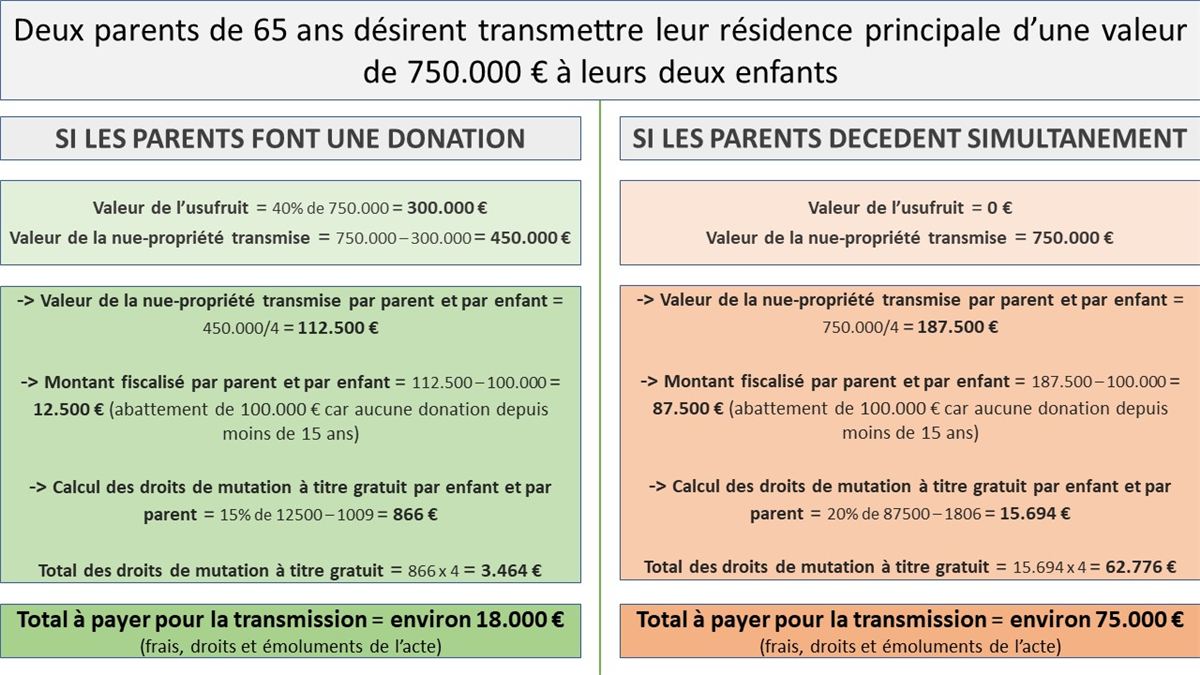
Let us take the example of 2 parents aged 65 who wish to pass on their main residence, worth 750,000 euros, to their 2 children. With this very simple arrangement, the value of the 2 parents' usufruct is 40% of these 750,000 euros, i.e. 300,000 euros. From a tax point of view, “only” 450,000 euros will therefore be passed on. Since there are 2 parents giving and 2 children receiving, this represents 112,500 euros per line of gift (450,000/4). With an allowance of 100,000 euros per parent and per child, each line of gift will be taxed on only 12,500 euros, which represents tax of 866 euros per line, i.e. 3,464 euros of duties in all. Added to the costs, duties and fees of the deed, the total to be paid will be about 18,000 euros.
Now let us compare the same family with the simultaneous death of both parents before any transfer: since no usufruct can be deducted, each child will inherit from each parent a value of 750,000/4 = 187,500 euros. Thanks to the 100,000-euro allowance, tax will be charged on “only” 87,500 euros, generating inheritance tax of 15,694 euros per line, i.e. a total of 62,776 euros for the two children. With the related costs, the total resulting from the two successions will be close to 75,000 euros: 4 times more for an inherited estate than for an estate passed on in advance. The only condition for keeping the benefit of this arrangement: the donors must live for at least three months after the gift.
It is no coincidence, by the way, that in 2018 a member of the French National Assembly called for usufruct to be abolished altogether, like some of our neighbours (the English in particular) who do not recognise this division of ownership.
This technique should, however, be used sparingly and wisely; but combined with other arrangements, such as changes of matrimonial regime and the Pacte DUTREIL (collective undertakings to retain shares), the result can be to divide the tax bill by 10!
Family harmony, the ages of the parents and children and the couple's overall estate will have to be assessed before going ahead. For that, there is only one solution: consult your notaire beforehand!
(Infographic below in French.)